Dreamscape
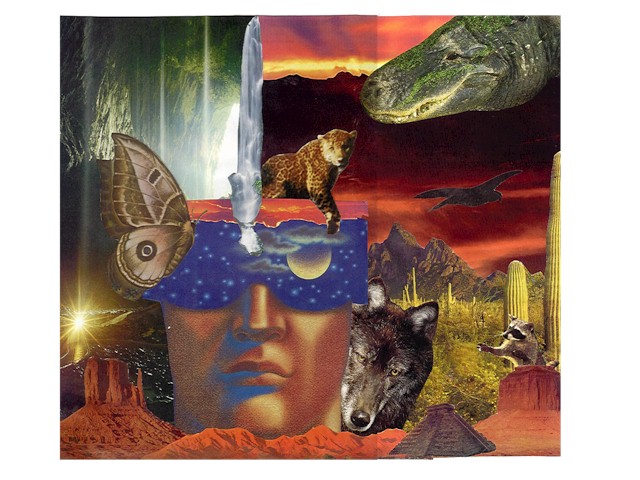
I drank the waters from the magic spring,
I saw the wolf.
“Come with me,” he said,
“Come and I will show how to dream.”
I followed.
We walked towards the fire in the sky,
to the mountains that beckoned me to come.
He lead me to a cave.
The iguana guarded the entrance.
“You come to claim the knowledge,
are you ready to see?” she asked.
I nodded, she stepped aside.
The jaguar was waiting silently.
She looked into my soul.
“You come to learn of power and of spirit,
are you ready to die?” she asked.
I nodded, she stepped aside.
I walked to the light within the darkness,
the month flew to me.
On its wings I saw the truth.
I walked back to the land I call my home.
The raccoon was waiting,
“You have returned,” he said, “tell me of your journey,
tell me of freedom.”
I sang the song the eagle taught me.
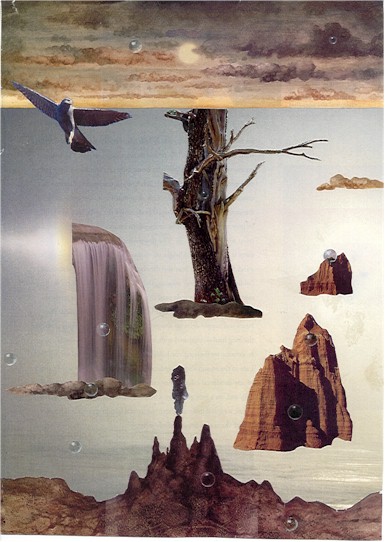
| I embrace the mountains of the North
And run on ancient paths, I am water. I give life its undulating rhythms, Soothing and eternal, I am water. I leave the heavens so I may Touch the earth, I am water. I am the passion that burns brightly,
I play with the trees of ancient forests,
|
In an all-consuming pursuit to build its technological landscape and express itself through abstract thought, the West has become detached from the animate world; entrenched in the patterns of its own culture, such as the hierarchical beliefs preached by Judeo-Christian religions, the unyielding aims of economic interests, the pedantic affirmations of orthodox science which see nature as “consisting solely of extended matter” (Sheldrake 1994:48), and the ever increasing abstraction of language, it has created a dichotomy between itself and the rest of nature. With all its inventions and dialectical doctrines, modern culture has ordained itself ruler over the natural world and no longer maintains a reciprocity with the earth. As a consequence, it sees traditional cultures and particularly shamans, who adhere to the ancient beliefs of a oneness with the elements of the Earth, as “the victims of a pathetic fallacy” (Sheldrake 1994:21); and like their world and the experiences with in it, the language of shamans has become incomprehensible.
No longer able “to give voice to the world from our experienced situation within it” (Abram 1997:47), we either turn a deaf ear to stories from other realms of perception or as much as try, are unable to appreciate their dialogic nature, let alone grasp the essence of their meaning. The monologue quality and linear syntax of our own language reflect our propensity toward rigid logic and structure and reaffirms our separateness from the natural world, now finding ourselves as outsiders, “we are unprepared to understand...the dream-space intensity of [the shamans’] vision[s],...and [their] language of participation and experience” (Ridington 1996:468). In order to begin making sense of their world and voice, we must realize that theirs is an ongoing intercourse and conversation with the natural world, fluid and ever-changing. As Ukula, a shaman from Arizona explained, our interpretations cannot
WATER AND FLUIDITY
The murmur of a crystalline stream that winds through the forest, the rushing white rapids of a mighty river, the blue expanse of the sea becoming one with sky in the horizon, a close proximity to Water and we are filled with a sense of joyful familiarity. Even in the enclosed artificiality of our cities we cannot forget that there was a time when Water was our home and “we thrived in the oceans” (Ackerman 1990:20). To our ancestors, not only were “[t]he healing and life-giving powers of [W]ater magical” (Ferguson 1996:84), its wondrous fluidity provided them with the means by which to venture out into the unknown, to explore worlds beyond the reach of their immediate vicinity, and experience first hand the marvels of the Earth.
To shamans it is not only beauty and magic, “in their knowledge that
the Earth is rooted in [W]ater” (Dunsmore 1997:64), they are also aware
that from its depths flows energy and power, and thus, holds a very important
place in their traditions. The sorcerers of ancient Mexico “believed
that Water had been given...not only for life, but also as a link, a road
to the other levels” (Castaneda 1984:90), a means of transport to other
realms. The link between the sacred and natural Water places is evident
in the Maya world, where shrines were situated “close to natural springs
or other [W]ater sources” (Freidel, Schele, & Parker 1993:188).
All shamanistic traditions consider Water sources sacred, however the Water
emitting from springs is believed to be infused with a particular power.
In some cultures, the crystals used by shamans in their ritualistic practices
are said to be brought forth by Water flowing from deep within the Earth.
The crystals’ magical properties of transparency, illumination, and inner
light—reminiscent of water—aid the shamans in healing and enhance the power
of their visions.
| I was seized
and taken far to the very edge of the world by the spirit, the magic power, the crystal, ha wo ho. I have come with the living waters, these healing ways of the Wolves, the living waters, the spirit crystal, ha wo ho. (Kalweit 1988:223) |
|
The sunrise I’m going with.
The sunrise I’m following.
With zigzag lines I’m painted.
Following the sun,
With zigzag lines I’m painted.
|
(Loendorf & Douglas:6). |
Theirs is not a linear discourse, and like Water, its meaning can escape
through ones fingers, evaporating and becoming invisible if we try to analyze
it from a strictly western perspective. One must become a participant,
immersing oneself in its rhythm, and the “rippling rise and fall of the
voice” (Abram 1997:80), allowing its flow to transport us to the “subjective
space” of the universe.
FIRE AND LIGHT
Few things can fill us with such wonder as a sunrise. As we watch the enormous bright golden orb of the Sun fill the world with light, and feel its warmth envelop the Earth, we reestablish the primal knowledge that “[s]unlight rules most living things with its golden edicts” (Ackerman 1990:257), and instinctively we remember that everything in the world, including us, is made of star dust. Deep within our being burns the knowledge that we are all the children of the Sun, and we can understand why our ancestors worshipped it as a god.
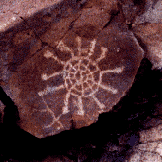 It
is believed that the Sun petroglyphs found throughout many sites of California’s
Coso Desert, were made by shamans while in a state of trance. The figure
consists of concentric circles and lines that represent the sun’s rays
and emit from the axis. Reminiscent of a web, it seems to represent our
connection to the stars and the knowledge that life in the universe is
interwoven with many realms of perception.
It
is believed that the Sun petroglyphs found throughout many sites of California’s
Coso Desert, were made by shamans while in a state of trance. The figure
consists of concentric circles and lines that represent the sun’s rays
and emit from the axis. Reminiscent of a web, it seems to represent our
connection to the stars and the knowledge that life in the universe is
interwoven with many realms of perception.
| Woman of the Southern Cross am I.
Woman of the first star am I. Woman of the Star of God am I. For I go up into the sky. (Halifax 1982:88) |
Fire plays a central role in many of the creation stories of traditional cultures. For the Maya “the first act of the gods was to create the hearth at the center of the universe where the first Fire of Creation could be started” (Freidel, Schele, & Parker 1993:79). For the Toltecs, the Sun was born out death; having been told that the only way to ignite it was to jump into a huge fire atop a pyramid, the gods were driven back by fear. However, the brave god Nanautzin, “without a moment’s hesitation, hurled himself into the flames, burning up with a great crackling sound, his blazing garments of reeds lighting up the sky” (Erdoes & Ortiz 1984:167). It is a shamanistic belief that Fire possesses a magical purifying quality with its flames bringing forth illumination and destroying unwanted forces.
To shamans, Fire related to ecstasy and symbolic of life and purity, is not only an external force to be controlled and mastered, but also represents transmutation and “the highest spiritual manifestation of totality” (Halifax 1982:90). Its light brings about changes and healing allowing them to become “acquainted with the world of the spirit, and spiritual reality” (Kalweit 1988:202); and enabling them to see into the darkness and experience first hand the hidden aspects of reality and the secrets of life and death. To the shamans of ancient Mexico, Fire had “a most peculiar quality. [It could] transport [them] bodily, just as water [did]”, and they used the “magical properties [of flames] as a means for bodily transportation to [other] realms” (Castaneda 1984:83).
The smoke that Fire produces is also used by some shamans to cross over
into the spirit world. The curanderos of Venezuela and other Latin
American countries smoke cigars, and as they blow the smoke into the four
cardinal directions, it envelops them like a cloud and transports them
to the realm of the underworld. The medicine-men of North America
not only consider their pipe a “symbol of the union of nature and
culture” (Halifax 1982:89), but its magical smoke goes directly to the
spirit world as they offer it to Wind.
AIR AND WIND
Without Air there would be no life, this we know. From the instant we take our first breath, it envelops, embraces and nurtures, infusing every cell of our body and feeding our blood, only to leave us only at the moment or our death. Life-giving and eternal, it is a “richly textured presence” (Abram 1997:26), carrying the echoes that reverberate since primordial time and the aromas that trigger the memories of our distant past. It is an unseen enigma as well, that unites us with the all the other sentient life, and with the land itself.
The Wind is the breath of the Earth, alive and ever-changing, forever in motion, moody and unpredictable. It can be a calm zephyr, filling us with a light-hearted feeling of joy or a mistral, hard and cold, reminding us of its awesome power. It can be a hurricane, dreadful in its destructiveness, or a monsoon, fertile and renewing. From the beginning of time, we have marveled at its playfulness as it moves through the fields and forests rustling the leaves of the trees. We have been awed by its ability to shape the very face of the Earth as it carves the mountains and sweeps across the land. We have been mesmerized by its power to allow us to communicate with all the beings of the animate world, and carry us out of our daily existence to make contact with the other realms of the universe.
If we take a few moments and make a conscious effort to let go of our
all consuming thoughts, worries, and obsession with the future, and immerse
ourselves in the here-and-now, we can become aware of the rich texture
of the Wind. Within seconds we notice that it carries a symphony
of sounds—the chirping of the birds, swishing whisper of the leaves, cries
and calls of other animals, and perhaps the echo of distant laughter.
We can also feel the Wind, for it may carry the warm, soft caress of spring,
the frigid grip of winter, the hot embrace of summer, or the cool, refreshing
touch of autumn. We can smell it as it is the keeper of the sweet
fragrance of the flowers, the refreshing, briny aroma of the sea, the clean
and sultry emanations of freshly tilled soil, and the sometimes not too
pleasurable scent of our fellow humans. But let ourselves once again
be engulfed and distracted by the avalanche of our thoughts and this sublime
tapestry instantly disappears becoming a short-lived memory, like the enigmatic
fragrance of a delicate perfume, that briefly captures our imagination
but disappears before we could determine its origin. Having become
so removed from nature, we must now consciously make an effort to feel
its presence and to decipher the messages carried by the Wind, something
that was second nature to our ancestors and that has never been forgotten
by shamans.
| unmoved
from time without end you rest there in the midst of the paths in the midst of the winds you rest covered with the droppings of birds grass growing from your feet your head decked with the down of birds you rest in the midst of the winds you wait Aged one. (Abram 1997:71) |
Like a messenger from the four directions and from all distances and
time, the language of shamans communicates the moods and feelings of the
sentient world. The richness of its rhythm engulfs us like the Wind,
and transports us to the place of the organic where nature can be experienced
deeply and directly. It is a subjective journey ethereal in quality
like the Air that we breathe, and impossible to comprehend if we have forgotten
or never learned to listen and decipher its murmurs. Only by internalizing
the sensual and reciprocal nature of their language can we ever hope to
understand it. If we can reestablish a propinquity with the complex
rhythms of the natural world, and realize that the shamans’ language is
but a reflection of this kinship, we can perhaps begin to appreciate its
lyrical quality while comprehending that like Water, Fire, and Air, language
is not only a gift from the Earth it is also a means to become one with
it.
EARTH
| The Earth is my body.
I never gave up the Earth. Creation’s Fire in all things. (Dunsmore 1997:53) |
|
Tired of all who come with words, words but no language
I went to the snow-covered island.
The wild does not have words.
The unwritten pages spread themselves out in all directions!
I come across the marks of roe-deer’s hooves in the snow.
Language, but no words.
|
(Abram 1997:137) |
REFERENCES
Abelar, Taisha. (1992). The Sorcerer’s Crossing. New York: Viking Arkana.
Abram, David. (1997). The Spell of the Sensuous. New York: Vintage Books.
Ackerman, Diane. (1990). A Natural History of the Senses. New York: Vintage Books.
Castaneda, Carlos. (1984). The Fire From Within. New York: Simon & Schuster.
Cowan, Eliot. (1995). Plant Spirit Medicine. Oregon: Swan Raven & Company.
Donner, Florinda (1985). The Witch’s Dream. New York: Simon and Schuster.
Dore, Gary. (1988). Shaman’s Path: Healing Personal Growth and Empowerment. Boston: Shambhala
Dunsmore, Roger. (1997) Earth’s Mind. Albuquerque. University of New Mexico Press.
Edwards, Dean. (1998, March 3). “Shamanism General-Overview.” <http://deoxy.org/shaover.html>.
Erdoes, Richard and Alfonso Ortiz. (1984). American Indian Myths and Legends. New York: Pantheon Books.
Ferguson, Diana. (1996). The Magickal Year. Maine: Samuel Weiser, Inc.
Freidel, David, Linda Schele, and Joy Parker. (1993). Maya Cosmos: Three Thousand Years on the Shaman’s Path. New York: William Morrow and Company, Inc.
Graulich, Michel. (1997). The Myths of Ancient Mexico. Norman: University of Oklahoma Press.
Halifax, Joan. (1982). Shaman: The Wounded Healer. New York: Thames and Hudson.
Harner, Michael. (1997, March). “A Different Drummer.” Natural History, pp 17-18.
Harner, Michael J. (1998, March 3). “The Sound of Rushing Water.” 1968. <hppt://deoxy.org/rushingw.htm>
Heart, Bear. (1996). The Wind Is My Mother: The Life and Teachings of a Native American Shaman. New York: Clarkson Potter.
Hultkrantz, Ake. (1987). Native Religions of North America. San Francisco: Harper & Row.
Kalweit, Holger. (1988). Dreamtime and Space: The World of the Shaman. Boston: Shambhala.
La Flesche, Francis. (1995). The Osage and the Invisible World. Ed. Garrick A. Bailey. Norman: University of Oklahoma Press.
Laughlin, Robert M.. (1998). Mayan Tales for Zinacantán. Ed. Carol Karasik. Washington, D.C: Smithsonian Institution Press.
Loendorf, Larry and Amy Douglas. “With Zigzag Lines I’m Painted: Shamanism and Rock Art.” Archeology and Public Education, pp. 6-13.
Mackenzie, Donald A. (1996). Myths of Pre-Columbian America. Toronto: General Publishing Company.
Mizrach, Steve. (1998, 3 March).“Ayahuasca, Shamanism, and Curanderismo in the Andes.” <http://www.clas.ufl.edu/users/seeker1/scholary/yage.html>
Ridington, Robin. (1996). “Voice, Representation, and Dialogue: The Poetics of Native American Spiritual Tradition.” American Indian Quarterly, 20, 486.
“Shamanistic Death Song.” (1998, March 3).<hppt://deoxy.org/3dethsng.htm>
Sheldrake, Rupert. (1994). The Rebirth of Nature. Rochester: Park Street Press.
Smithson, Carma Lee and Robert C. Euler. (1994). Havasupai Legends. Salt Lake City: University of Utah Press.
Taussig, Michael T. (1987). Shamanism, Colonialism, and the Wild Man: A Study in Terror and Healing. Chicago: The University of Chicago Press.
Ukuala, (1998, March 20). Personal Interview.
Van Deusen, Kira. (1998). “Shamanism and Music in Tuva and Khakassia.” Shaman’s Drum, 47, 22-29.
Villoldo, Alberto and Erik Jendresen. (1990). The Four Winds. San Francisco: Harper & Row.
Vitebsky, Piers. (1997, March). “What is a Shaman?”
Natural History, pp. 1-2.